On a multi-trade construction project, the crane is the most contested resource on site. The steel erector needs it for picks. The concrete crew needs it for bucket pours. The mechanical contractor needs it for rooftop units. The precast team needs it for panel sets. Everyone has a schedule. Everyone needs the hook. And when hook time runs over for one trade, every trade behind them absorbs the delay.
Managing crane time across multiple trades has always been a negotiation. With 4D BIM, it becomes a data problem, and data problems have better solutions than arguments in the field trailer.
The Multi-Trade Crane Problem
The core issue is simple: one crane, multiple trades, not enough hours in the day. The GC allocates crane time in the schedule, typically by block: steel gets the crane Monday through Wednesday morning, concrete gets Wednesday afternoon through Thursday, mechanical gets Friday. In theory, this works. In practice, it falls apart within the first week.
Trades run over their allocated time. The concrete pour takes longer than planned, and now the steel erector loses two hours of hook time they were counting on. The erector can't make that time up without either working overtime or pushing their sequence into the next week. Both options cost money.
Nobody agrees on what actually happened. The concrete crew says they finished on time. The steel erector says they didn't get the crane until 2 PM instead of noon. Without objective data, the conversation becomes a credibility contest. The GC mediates based on whoever makes the most convincing argument, not based on evidence.
The erector absorbs the cost. When a trade transition delay costs the raising gang an hour of idle time at $1,000 per hour, that cost typically falls on the erector. Recovering it requires documentation that proves the delay, attributes it to a specific cause, and quantifies the impact. Most erectors don't have that documentation because nobody was tracking it at the time.
How 4D BIM Changes the Conversation
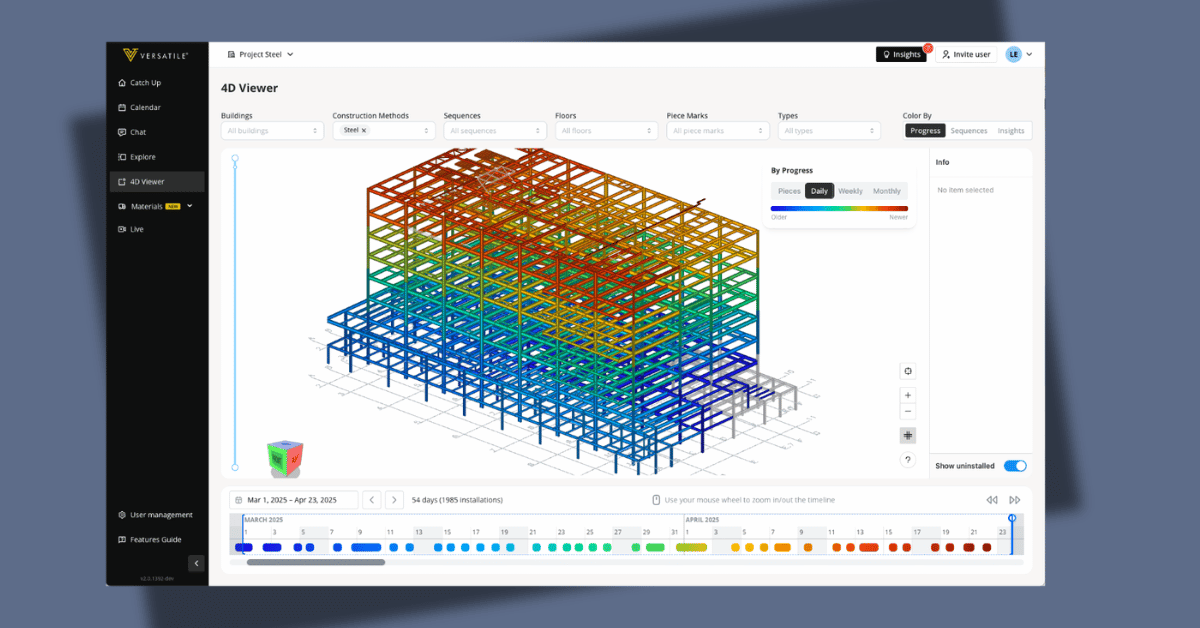
A 4D BIM viewer adds time to the 3D model. Every crane activity is logged with a timestamp, a location, and a trade association. When that data is visualized on the model, the crane schedule stops being an abstract allocation on a Gantt chart and becomes a visible, verifiable record of who used the crane, when, and for what.
Hook time by trade becomes objective. The crane intelligence system captures every pick automatically. Each pick is associated with a trade based on the activity type and the zone. The 4D view shows exactly how many hours each trade used the crane on any given day, color-coded on the model. When the steel erector says they lost two hours of hook time, the data either confirms it or doesn't. The argument is over before it starts.
Trade transitions become visible. The gap between when one trade finishes with the crane and when the next trade starts using it is a transition period that usually goes untracked. In the 4D view, that gap is visible as idle time between two color-coded blocks. On some projects, transition gaps add up to 30 minutes or more per handoff. Across a week with daily trade transitions, that's hours of lost production that nobody was measuring.
Schedule conflicts surface early. When the 4D view shows that steel erection is running two days behind the planned sequence in zone 3, the GC can see how that affects the concrete schedule in the same zone before the conflict becomes a crisis. The model shows the dependency visually: the concrete crew can't start until steel is complete in that area, and steel is behind. That early visibility gives the GC time to adjust, reschedule, or bring in additional resources before both trades are standing in the same zone arguing about priority.
"The 4D view made it impossible for anyone to claim they didn't get their crane time. The data was right there." (PM, commercial GC)
What the GC Gets
For the GC managing multiple trades on a single crane, 4D BIM provides three things that schedules and meetings can't.
An objective allocation record. Instead of relying on each trade's self-reported crane usage, the GC has a verified record of who had the hook and for how long. This record is timestamped, tied to the model, and not subject to interpretation. When the weekly coordination meeting turns into a debate about hook time, the GC can pull up the data and settle it in minutes.
Better scheduling decisions. When the GC can see actual crane usage patterns, they can optimize the allocation. If the data shows that steel consistently finishes its allocated window 45 minutes early on Wednesdays, that time can be reallocated. If concrete consistently runs 30 minutes over, the schedule can account for it instead of pretending it won't happen again.
Documentation for delay claims. When one trade's overrun causes another trade's delay, the 4D data documents the chain of cause and effect. The steel erector was scheduled to start at 7 AM. The crane wasn't released from the concrete crew until 8:15 AM. The erector lost 1.25 hours of production. That documentation exists automatically, without anyone needing to anticipate the claim.
What the Erector Gets
For the steel erector working on a multi-trade site, the value is margin protection through documentation.
Every hour of crane time the erector loses to another trade's overrun is an hour the raising gang is on the clock but not producing. At $1,000 per hour, those losses add up fast. Without documentation, those costs are absorbed. With 4D data showing exactly when the crane was supposed to be released and when it actually was, the erector has the basis for a backcharge or a schedule extension.
The data also helps the erector plan around the reality of shared crane time. If the pattern shows that the erector consistently gets the crane 20 minutes late after the morning concrete pour, the foreman can plan staging and rigging to account for that gap instead of having the crew standing around waiting.
Making Multi-Trade Sites Work
Multi-trade crane scheduling will always involve coordination, compromise, and the occasional disagreement. What 4D BIM eliminates is the ambiguity. When every pick is logged, every trade's crane time is measured, and every transition gap is visible on the model, the coordination conversation changes from "he said, she said" to "the data shows." That's a better conversation for the GC, for the erector, and for every trade on site.
The crane is the most expensive shared resource on a construction project. Every stakeholder on site deserves to know how it's being used. Crane intelligence makes that transparency automatic, and 4D BIM makes it visual.